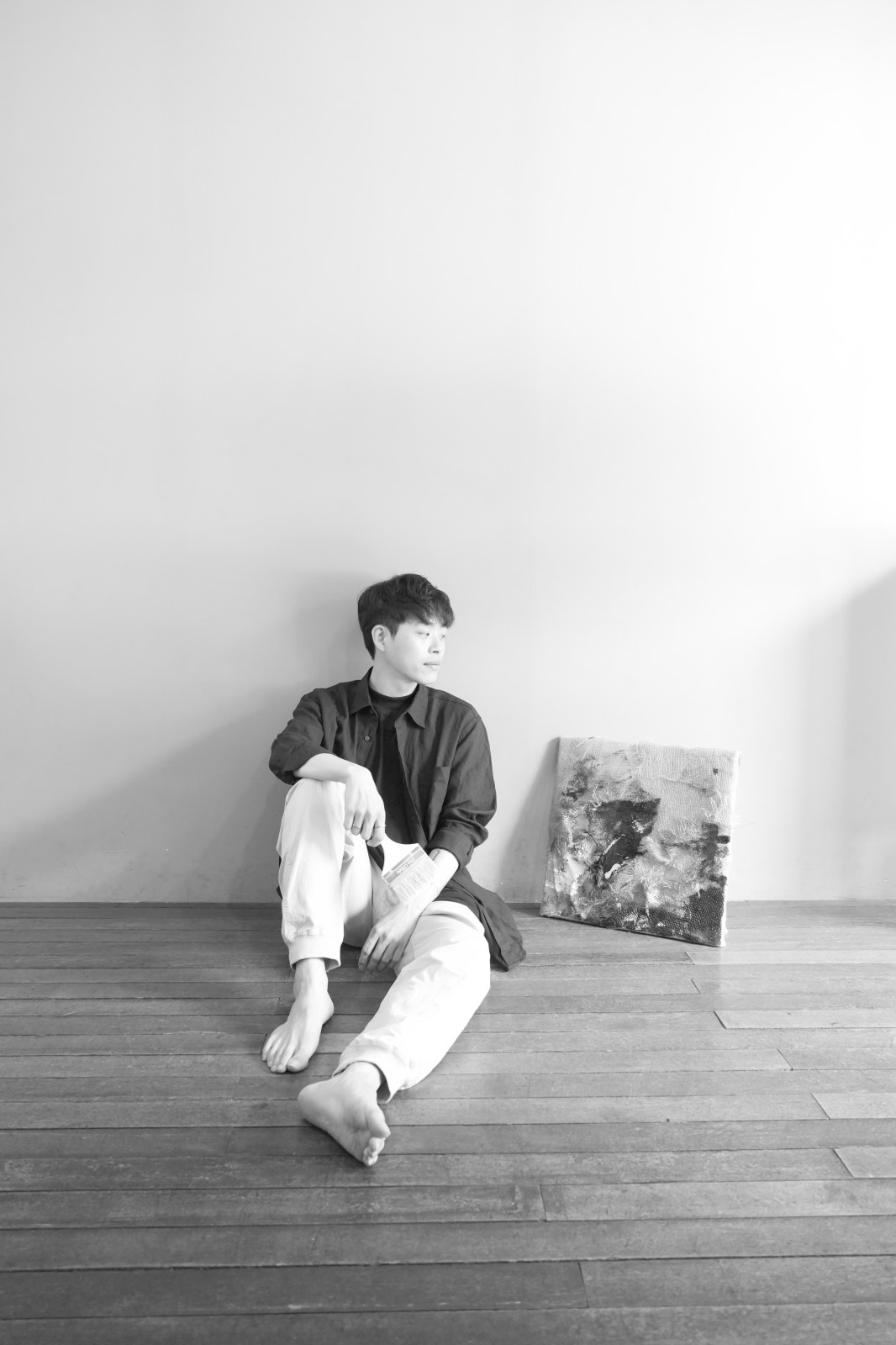
I have spent my life dipping a toe into things. Film, music, games, painting — I entered many, finished none. Painting is the first thing I want to see through to the end.
So I treat painting as a practice. With materials my body learned in Korea, I hold myself steady in a foreign place.
I grind ink. I press the hardened stick against the inkstone and grind it with water, hundreds of times, until the black pours out. With that black I wet the wooden panel and build a ground. Over it I lay hanji, sheet by sheet, pour shellac, and scrape it back. Pouring and scraping, thousands of times. Some areas soak through and become one with the panel; others fall away for good. Sometimes I draw that boundary myself; sometimes I step back and let it be drawn — both are the same practice. From making the material to raising the surface, I hold a restless mind still inside that long repetition.
I do not change my materials. Always hanji, ink, and shellac; always the same repetition. Within that, I raise a different form each time. Sometimes a surface with no image at all, sometimes the iconography of an old painting, sometimes a construction built from stacked fragments. These are not stages, one finished before the next begins — they are different faces of the same practice. What stays constant is the material and the act; what changes is the form that rises from them.
Not everything we live through stays with us. What we tried to hold fades; what we barely noticed sometimes remains. Everyone carries a buried place — if only I had gone the other way. We live with it unresolved, like a task we mean to return to someday.
My surfaces are a topography of that staying and vanishing. I do not paint with the flash of a genius; I grind, layer, scrape, and erase, quietly. An imperfect permanence, built from imperfect things. If those who stand before it recall, for a moment, the places they have buried — that is enough.